For a successful benchmark, general guidelines have been sent to all the participants
Guidelines
Sample preparation
The preparation of samples to fit the needs of the individual researchers was a challenge and a large part of the credit goes to the environmental geomechanics research team at McGill who spent a great deal of time performing the coring and machining them to fit the specific dimensions indicated by the investigators. The Cobourg Limestone displays some nominal evidence of “stratification” resulting from a nodular fabric (the light grey rock) that contains calcite and dolomite interspersed by the partings (the dark grey rock) that contains calcite, dolomite and a clay fraction. The prepared samples were cored mainly perpendicular to these nominal stratifications. Some of the participants were sent block samples, which saved a great deal of time in the end. Instructions were sent to make sure that the colleagues who were preparing their own test specimens performed the coring and machining using the same feed rates and rpm used at McGill.
Experimental procedures
Background of the Project involving the Cobourg Limestone: The Cobourg Limestone is the primary argillaceous host rock formation that will be encountered at a depth of approximately 600 m, at a site that is being considered by the Nuclear Waste Management Organization (NWMO) for the siting of a low- to intermediate-level nuclear waste. The Cobourg Limestone and the adjacent strata have been investigated by a number of Universities and consultants to NWMO : papers and reports can be found at the following link:
http://www.mcgill.ca/civil/people/selvadurai/kcl-project
Sample Orientations: the rock displays some nominal evidence of “stratification” resulting from a nodular fabric (the light grey rock) that contains calcite and dolomite interspersed by the partings (the dark grey rock) that contains calcite, dolomite and a clay fraction. The samples that you received were cored mainly perpendicular to these nominal stratifications.
The Testing: The primary objective of the KCL project is to generate consensus regarding the “intact” permeability of an unstressed sample of the Cobourg Limestone. To provide some basis for comparison of the results, it is useful to provide some guidelines with respect to the traditional approaches that are employed in permeability testing:
- The saturation procedure is an important item with regard to the interpretation of data. Various researchers tend to use procedures that will work for rocks that they are familiar with. The procedure followed at McGill is provided in a separate document and can be used as a guideline.
- The tests can be carried out under the traditional steady state or transient conditions or other techniques such as the pore pressure oscillation technique and the one-step pulse method, etc. If additional geomechanical parameters (compressibility of grains, skeletal compressibility, porosity, etc.) are needed, for the interpretation of tests, they need to be obtained from either published literature or by conducting post-permeability geomechanical testing.
- There are no restrictions on the type of fluids that can be used in the tests, provided there is no chemical incompatibility that can lead to alterations in the calcite-dolomite rich fabric. The water can be either de-ionized and/or deaired using some form of Helium parging technique, but this is not mandatory. The pH can be between 6 and 8 or 7 as in the case of tap water. At the proposed site for the repository, the in situ fluids are highly saline (TDS (200-350)g/Litre).
- The isotropic or confining stress state that is needed to establish sealing between the sample and a sealing membrane should preferably be kept to less than 5 MPa. If the participants are interested in examining permeability evolution with changes to the isotropic stress state, the tests can be conducted to isotropic compressive stress states up to 30 MPa similar to the KG2B Project
Recommendation
Once you have finished your measurement, we kindly ask you to keep the sample in good shape until the end of the benchmark. For example in the event of a value being significantly off the trend, we may ask for a cross checking, i.e. another lab could measure the permeability of your sample, and conversely you might be asked to measure a sample from another group.
Want to do more?
You are welcome to provide any interesting result obtained on your sample to the community (density, porosity,…).
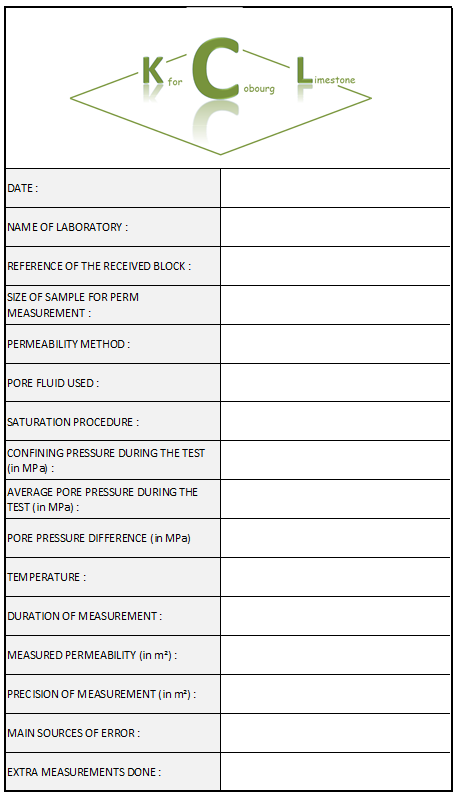
Results sheet to be filled by each participant
Sponsors